
Agent Skills and the impact on individuals and organizations
Shivani Jindal, Northwestern University Kellogg School of Management MBA and Tensility intern
Wayne Boulais and Armando Pauker, Managing Directors, Tensility Venture Partners
Introduction
Frederick Winslow Taylor spent the 1880s observing factory workers at work. He timed their movements, documented their methods, and turned tacit craft knowledge into written procedures anyone could follow. Once their expertise was on paper, the work could be taught to others, and the skilled worker became less scarce (reference).
The same dynamic is playing out in white-collar work today (reference). In October 2025, Anthropic introduced Agent Skills, a system that allows AI agents to load and gain access to institutional knowledge and complete autonomous workflows via simple files called SKILL.md. Unlike a chat prompt, a SKILL.md file persists across sessions, scales across a team, and is transferable across major AI platforms. It is effectively machine-readable institutional knowledge. Before Skills, every AI conversation with an LLM started from scratch: you re-explained context, re-specified preferences, re-prompted for consistency. Skills change that. They encode not just what to do, but how you specifically do it: your research process, your communication style, and your judgment calls.
You can learn more about Agent Skills here .
Skills adoption is accelerating. In just the past six months, tens of thousands of Skills files have been created and shared publicly (reference). Individuals are creating Skills files that reflect how they think and work. Enterprises are beginning to encode their employees’ workflows into these structures. What few people are recognizing: Skills make white-collar expertise portable for the first time, and the line between what belongs to you and what belongs to your employer is about to get more contentious.
A framework for thinking about Skills
Not all Skills are created equal, and the context in which they are built has real implications. It helps to consider two questions: What kind of knowledge are you encoding? And where are you using it? The answers place any Skill into one of four categories, as seen in Figure 1 below.
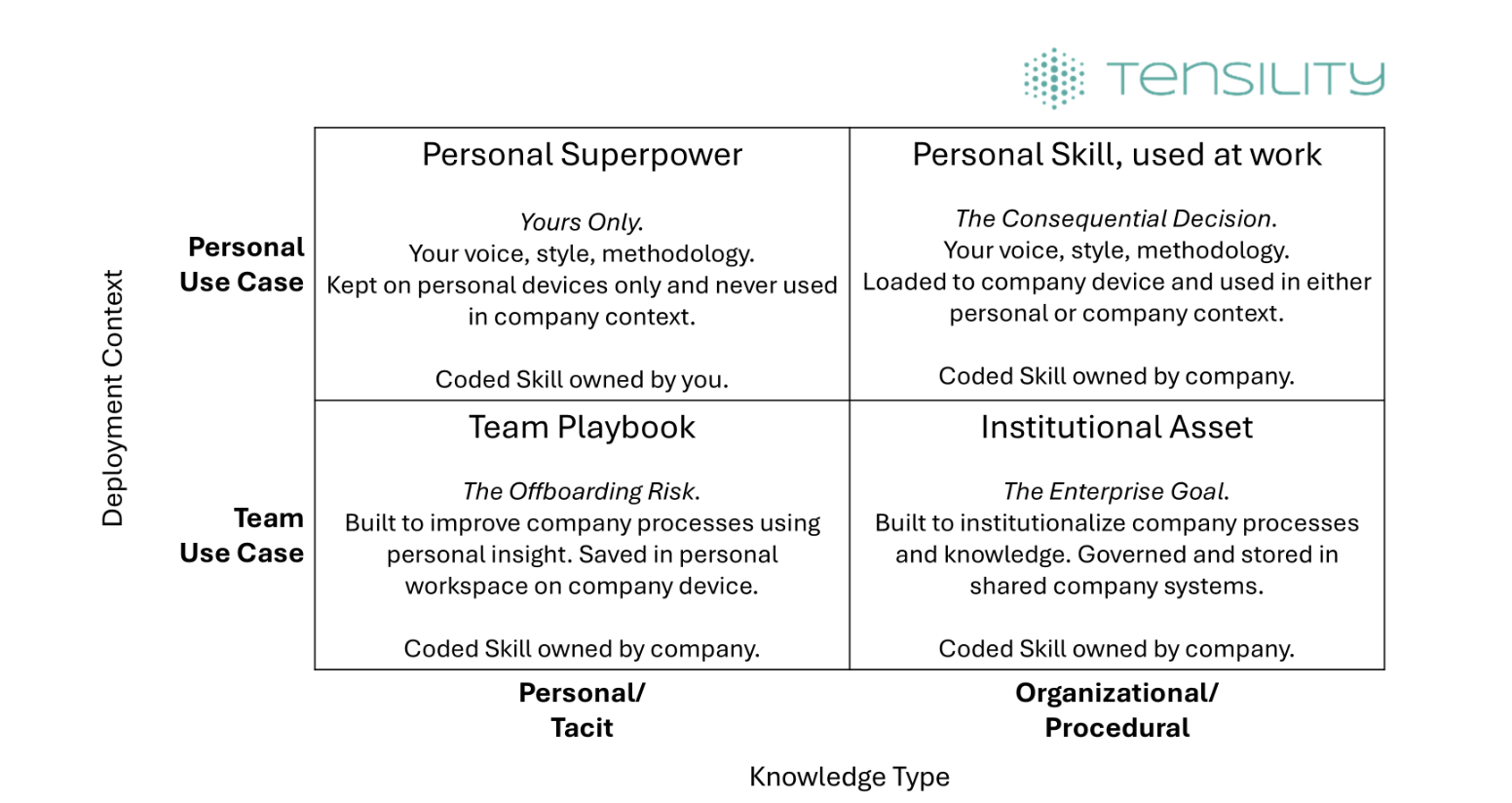
Figure 1 Implications for Skills usage based on deployment context and knowledge type
Personal Superpower (personal use case with personal knowledge): Consider a senior consultant who has spent years developing a research methodology across multiple firms: how she structures a market analysis, which signals she weights, and how she communicates findings to different stakeholders. She encodes this into a Skill on her personal laptop. It captures her voice, her judgment, her approach — the know-how she has built over a career and carried from role to role. Before Skills, that knowledge lived only in her head. Now it is portable in a form she can use across contexts. Built on personal time and kept off company systems, this Skill is unambiguously hers. However, the moment she uses it at work, that changes.
Personal Skill, used at work (personal use case with organizational knowledge): The same consultant joins a new company and loads her personal Skill into the company's shared AI environment because it makes her immediately more productive. By deploying it at work to do company work, she has likely made it a company asset, the same way an Excel model built at work stays with the company when she leaves. She keeps the know-how to rebuild it, but the Skill file is no longer solely hers. Consider what that actually means: a junior analyst could load it and produce her quality of output. Her employer could run it without her. She still knows how to build something like it again, but that specific Skills file stays behind. This is a consequential decision, and most people won’t realize they’ve done so until later.
Team Playbook (team use case with personal knowledge): A product manager at a Series B SaaS company spends months building a Skill that encodes how his team runs sprint reviews: which metrics to surface, how to frame tradeoffs for engineering versus business stakeholders, and how to push decisions to closure. It lives in his personal Cursor workspace because that is where he built it. When he leaves, he cannot take the Skill — it is clearly a team asset. But if it is saved on a personal desktop or in a folder that gets archived, the company may quietly lose something valuable. The company would likely have a strong ownership claim, but it was never enforced. Here, governance matters: Skills built for team use need to live in shared, managed systems, and offboarding processes need to account for them before someone's last day.
Institutional Asset (team use case with organizational knowledge): This is where enterprises want to go: SOPs, compliance workflows,and brand guidelines encoded not just as documentation, but as executable and governed Skills living in shared company systems. Most organizations are not there yet, and the ones that reach this level deliberately will have a meaningful operational advantage. Skills redefine knowledge management as scalable institutional assets.
The output vs. the know-how
Legal courts have spent decades drawing a line between an employee's general skill and knowledge, which an employee owns and takes with them, and an employer's trade secrets, which the employee does not. A SKILL.md file sits uncomfortably along that line: more explicit than knowledge held in someone's head, more portable than institutional memory, but potentially not formal enough to qualify as a trade secret under current frameworks.
We presume that Skills will follow existing precedent: companies already own the work outputs employees produce. The Skill file would likely stay with the company, but the employee takes the know-how.
What makes Skills feel different and where it gets contentious is the personal Skill brought into a work context: “Personal Skill, used at work.” Think of your personal phone. Keep your files entirely off company systems and they are yours. Start using your personal files for work, and company policies begin to apply. The same goes for Skills. Employees may even start to consider protecting their Skills through frameworks tied to employment agreements. The gap between what employees assume they own and what companies will reasonably claim is where individual and organizational interests are most likely to collide.
The framework presented above focuses on salaried knowledge employees working within companies and startups. The matrix assumes the workplace rules, where precedents are being created today, around Skills files, employee knowledge and IP, will trend towards historic standards. However, there is a possibility that the norms on individual knowledge could change if there was a move towards collective bargaining over this issue. The Screen Actors Guild is the clearest example of contract-based workers successfully unionizing against the effects of AI displacement (Inc., 2025). As of 2024, private sector workers had a union membership rate of just 5.9% - and knowledge professionals make up a tiny fraction of that (Bureau of Labor Statistics, 2024). While some tech workers at Alphabet, Microsoft, and Kickstarter have begun organizing, these efforts remain embryonic.
Why this is especially acute for startups
For large enterprises, Skills management is an operational and governance challenge.
For startups, the stakes are higher. A Skills library built by a small founding team can encode something close to a business model: how decisions get made, how clients get handled, how edge cases get resolved. If a key early employee leaves with that library, they're not just taking institutional knowledge in their head; they're taking something immediately executable, already tested, and ready to deploy at a competitor. A large company has employment agreements and offboarding processes that make boundaries clear. For many early-stage startups, governance structures, employee handbooks, and employment agreements are not well established. The other side matters too. Telling employees that their Skills files are company property could discourage them from building personal agents in the first place, removing an incentive that benefits the company while the person is there. Both sides have a legitimate claim, but there is no clear framework.
What leaders should do now
Skills are being built right now, across organizations of every size, mostly without anyone having thought through the ownership implications. A few starting points:
For individuals: Skills built on your own time, on your own devices, and never used at work: yours. Skills built at work, or deployed at work, even if built personally: the company's file, your know-how. If you have Skills tied closely to your professional identity, including your voice, values, methodology, and judgment, keep them off company systems if you want to maintain sole ownership. Early adopters of Skills may have an opportunity to negotiate Skill ownership as part of employment arrangements before norms solidify.
For organizations: The same policies that govern employee work outputs almost certainly extend to Skills, and it's worth making that explicit before ambiguity creates friction. Skills that live in personal workspaces rather than shared, governed systems represent operational risk: when someone leaves, so does the institutional knowledge they encoded. Building toward the institutional asset quadrant with infrastructure on how to govern Skills and manage offboarding processes is how organizations can turn team expertise into a durable competitive advantage. One additional risk worth flagging: Skills files downloaded from public repositories or brought in from personal use introduce similar security exposure as any unvetted third-party code, and should be reviewed before deployment.
Taylor's factory workers didn't choose to have their craft documented. Today, knowledge workers building Skills are making that choice themselves, making this moment different. The decisions around AI outputs, agents, and Skills being made right now, mostly by default and without much fanfare, will set the precedents that govern this for years to come. While Taylor's workers had no say in what was encoded or where it went, today’s knowledge workers do.
References
Learn more about Skills, their specific syntax, how to use them, and how they work:
Taylor, Frederick Winslow. The Principles of Scientific Management. Harper & Brothers, 1911. Available at:https://www.gutenberg.org/ebooks/6435